
Astigmatism; Seeing a Distorted World

Written for
Earth Star Magazine April-May 2009
By Rosemary Gaddum Gordon, D.B.O., M.A.

If you have astigmatism, seeing is confusing. Parts of an image may be clear while other parts are fuzzy or double. Often there are multiple images. This happens when the cornea, the front surface of the eye, or the lens inside the eye, is warped; it is not symmetrical. This causes the image on the retina to be distorted. Uncorrected astigmatism often causes the eyes, mind and whole body to tire easily.

There are two kinds of astigmatism: regular and irregular. Glasses can correct the former, but not the latter, which is usually the result of an accident or disease process. Regular astigmatism can be corrected by Holistic Vision Improvement; the irregular can be helped and made more comfortable.

Astigmatic distortion in the eyes is often variable. It may even appear and then disappear. One vision student went to three different optometrists in one afternoon and was given three different prescriptions. Maybe you’ve noticed the moon or letters strangely changing shape sometimes.

One of the ways the cornea may become asymmetrical is if the muscles on the outside of the eyeball are pulling unevenly due to tension or strain. Activities you can do to correct this are to loosen these eye muscles. If you look at your prescription the strongest lens will be aligned with the direction of greatest distortion. The column listed “axis” will tell you this direction. Zero degrees is on you right, ninety degrees is straight up and one hundred and eighty degrees is on your left. With this in mind, move your head along an imaginary line at that angle to the ground. Let your eyes and mind be open to receive the images as they flow past; not stopping on any of the objects. Continue this a few times and then repeat the movement with your eyes closed, remembering what you would be seeing if your eyes were open. Open your eyes and repeat again. An alternative activity is to do this using a yardstick. Hold it out in front of you and move it at that same angle listed on your prescription. Move your head in the opposite direction to the movement of the yard stick as you gently brush your line of sight across the numbers.

If you don’t have a prescription, look at something with sharp lines on a good contrasting background, like a grid or letter on a chart or the moon in a night sky. Notice where any shadows or multiple images appear; they will be at your angle of astigmatism and that will be the angle of movement your eyes need. Often each eye has a different angle, so use a patch and loosen each set of muscles in turn. Palm and rest your eyes if they feel tired.

Interestingly, many immigrants develop astigmatism. Mine sometimes recurs, even after over 40 years here in the U.S. In a different country it’s easy to misread people’s behavior. Even though I speak English, I feel that I don’t really understand some situations. My daughter and husband, both born here, have been very helpful in explaining the culture to me. I see what’s happening, but it doesn’t always fit with my prior experience, my response is not always appropriate … there’s a mismatch, a distortion of my reality. I’ve had to change my understanding of what I see in order to fit into the culture in which I now live. It can be difficult, but also funny.

If you notice some astigmatism, relax and remember how variable it can be. Notice if you are in a situation where you are being asked to see the world differently than you usually do. If you are, decide where you stand, do a little of the brushing technique and notice what happens.
More Vision Tips

After Lasik: Avoiding Reading Glasses

Originally appeared in
Earth Star Magazine August/September 2008
By Rosemary Gaddum Gordon, D.B.O., M.A.

Lasik is a surgical procedure for the eyes that changes the shape of the cornea allowing the patient to see more clearly without glasses or contact lenses. More and more people are choosing to have this surgery and many are delighted with the results. You can find out about the pros and cons on the web.

One thing that Lasik does not correct is presbyopia, the reduction in ability to see up close as we age. Most eye professionals think it is impossible to prevent or reverse this deterioration, so they prescribe reading glasses. This means that most people who get Lasik end up in glasses anyway. However, just as other muscles weaken as we get older and can be strengthened, so can the muscles of the eyes.

The muscles that allow us to focus at different distances have to work harder the closer and smaller the object is to us. When they are strained they lose their flexibility and strength and near vision deteriorates. The common reasons for straining these muscles are over-use or mental stress. Often there is a combination of the two. The reason why it tends to happen as we age is, I believe, similar to why our bodies break down in other areas, there are not enough nutrients reaching the tissues.

If we care for these muscles we can prevent or reduce our dependence on glasses. This involves giving them the rest and exercise they need, as well as eating well and doing activities that promote good circulation. Here are a few of the things you can do:

Rest your eyes by palming. Support your elbows and cover your closed eyes with the palms of your hands so you are blocking out the light and not touching your eyes. Find something to gently rest your mind on. For some of us the blackness caused by the palming is enough, for others it is best to imagine or remember being in a beautiful place. Actually pretend you are there, seeing the beauty, hearing the sounds, feeling the air and the delight. Palm until your whole being feels rested.

To increase or maintain the flexibility of you eye muscles change your focal distance often. When you are driving, you can briefly focus on the dashboard or the steering wheel every five minutes. When you are working on the computer or reading, focus twenty or more feet away every five minutes. You don’t have to look very long, just long enough to focus your mind there, so that your eyes will focus too; five seconds is often sufficient. If you notice that your eyes are tired or the focusing is sluggish, give yourself, your eyes longer. If you blink your eyes will change focus more quickly and easily.

One way to build stamina for reading and near work is to practice convergence or crossing the eyes. This was described in a previous issue.
Lasik surgery should not effect the eye muscles, so avoid reading glasses and preserve your good near vision. Of course, if you haven’t had the surgery, these techniques will also help you to avoid them.

More Vision Tips

A Color a Day keeps the Eyes in Play

Originally appeared in
Earth Star Magazine February/March 2009
By Rosemary Gaddum Gordon, D.B.O., M.A.

A Color a Day keeps the Eyes in Play

The eye is a light-catcher. To catch the light best it needs to be open and to move freely. So often our eyes feel tired and heavy. We give them repetitive tasks where their movement is restricted to back and forth along lines of print, or up and down from keyboard or desk to screen. Frequently the colors we see doing these tasks are also unchanging. This is dull stuff for a light-catcher.

Here is a game to enliven your eyes by looking for colors. Each morning pick a color, any color of the rainbow plus brown, white, black or grey. During the day you look for that color. This encourages your eyes to move around rather than to stare straight ahead. No need to search, be open to the color and let it come to you. This is the first part of the game. In some places like on the subway or at a sports event you might even count the number of red hats or green jackets. This is especially good to do with kids as long as there is no comparing of results, which might make it competitive.

In the second part of this activity, rather than thinking of hats or jackets, you just attend to the color itself. So, instead of a hat that’s red, it is redness that happens to be on a hat. It is just the color that counts. Let yourself absorb red. Take in redness. This is a different way to see for many people. It helps us to see from a deeper place. It allows us to be touched by what is coming in through our eyes. You will probably find it relaxing and pleasurable. You may notice that your visual field expands and that you are also seeing more details, even though you are not looking for them, you are just enjoying the color.

The world is full of colors. Everything has a color, unless it is pure black. As we’ve mentioned before, black is also wonderful for the eyes. It’s wonderful because the retina does not respond to it. It’s a blank for the receptors; emptiness. In this way it is restful and quiet for the whole visual system. If you have any black velvet take some time to look at it in this way; just absorbing it’s blackness. Notice how your eyes enjoy it. How soothing it is.

So too, you may notice various qualities about the different colors as you attend to them. Some of them are subtle and some more obvious. Sometimes the color will go by in a flash and sometimes you’ll be able to spend some time with it. The point is to encourage movement and receptivity.

As you play these games you will begin to notice how colorful the world around you is. Your light-catchers will move more freely and the whole of you will be more open to the richness of life. Enjoy!

More Vision Tips

Vision: A Variety of Skills

Take a moment to consider the many functions or skills which our visual system performs. Imagine you are in a field playing catch with a frisbee. Your eyes coordinate with your hands to throw the frisbee. They track the frisbee as it moves through space. They allow you to focus on it at a far distance, or close. They work together to allow you to perceive depth and distance. They recognize the color of the frisbee, and they hold an image of it in your mind so that when you hear the word “frisbee” a mental picture can be recalled.

When our visual system is healthy, the eyes, nervous system and brain allow us to see clearly in all of the varying conditions we encounter. They allow us to do tiny detail work up close, and to see clearly on the horizon. They adjust to bright sunlight and to night conditions. They give us depth and peripheral vision as well as central focusing ability.

The following is a list of visual skills which the healthy visual system maintains.

Acuity: Clear, sharp edges; the ability to read things that are near, and far away.

Accommodation: Flexibility to adjust our focus from distance to near and back to distance again and to be able to hold that “focus”. Important for keeping a focus when reading, for example.

Eye Movement: There are two different types of eye movements: fast, accurate saccadic movements that easily jump from one thing to another, and smooth, fluid movements that allow us to follow something like a ball, a bird, or an approaching car. The eyes need to be able to perform both types of movement with ease as they gather information.

Eye Teaming: Ability to coordinate the two eyes and the information received from them. The brain fuses the image from each eye together into one so that we see one image wherever we “look”, or point our eyes. Good fusion allows us to see in 3D.

Visual Perception: Understanding, recognizing and interpreting symbols, letters, and other forms.

Eye-Hand-Body Coordination: Synchronization of body movements with the perception through the eyes, for a myriad of tasks from handwriting to playing sports.

Visual Memory: Ability to remember or visualize images. Important for learning to spell, to remember numbers, details, and the way home!

Color Recognition: Ability to differentiate between colors.

Light Adjustment: Adjusting to varying light conditions, from watching stars, to being outside in bright sunlight, to driving at night with headlights coming toward you.

For most people, these visual skills are learned naturally in childhood. As long as children have appropriate stimulation, rest and nutrition, their ability to see well will develop over time.

For a growing number of people however, the ability to see clearly at all distances and to maintain the visual skills mentioned above, does not continue for a lifetime. At some point – usually after a period of stress – their vision becomes blurry and focusing is increasingly difficult.

In order to return to good vision, it helps to understand how the system is designed to function, and then to consciously re-establish relaxed, healthy seeing habits. This re-training of the visual system is the process of Vision Education.

Is My Nearsightedness Inherited?

Originally appeared in
Earth Star Magazine November/December 2005
Rosemary Gaddum Gordon, D.B.O., M.A.

When I was thirteen I was given my first pair of glasses. I asked the question most of us have, “How did I become nearsighted?” My ophthalmologist told me I had inherited it along with my brown eyes and there was nothing I could do about it. End of story. Since then I discovered there is more to the story. Not only has my eyesight recovered but several interesting studies have been done that point to other factors that impact our vision.

Two studies are of particular importance. One examined the vision of adult identical twins and found that very few of them wear the same glasses prescription, which if inherited anatomy were the sole cause of nearsightedness, we would think they would. Secondly, the vision of three generations of Inuits was measured and compared. While over half the children were nearsighted, very few of the parents and none of the grandparents were nearsighted. The major life-style changes which had occurred during the previous thirty years included the introduction of western methods of education, electricity and canned foods. From this we could wonder about several different possible causes. We could look at how western education compares to their previous forms of schooling. We could look at how having electric lights in a home changes a family’s way of life and we could explore what the addition of canned foods does to a peoples’ diets.

I am no expert on educational methods, but thinking about my and my children’s schooling, it required long hours looking at books and papers. If I imagine what the introduction of electric lights might do, I think of less sleep and more time looking at things within the walls of the house, perhaps more time sewing or reading. So the children seem to spend less time looking into the far distance and possibly sleeping, than did their parents and grandparents.

The nutritional aspects we will explore another time and, of course, emotional and mental stress play an important role, as we have been exploring lately in this column. But, how we use our eyes is vital. Our eyes muscles are very adaptable; they develop according to what we do. As muscles become thicker and stronger in response to constant near work and are not given stretching time, they lose their elasticity. There is no problem with eye muscles becoming stronger, but we do want them to retain their elasticity, otherwise they will lose some of their range of motion. Since the eyes are focused by muscles, this can restrict our range of focus. So, if we read for hours without looking in the distance, when we do look up it takes a while for the distant images to become clear. That adjustment time can take longer and longer until it takes too long and if we don’t change something about how we are using our eyes, we get glasses.

We do inherit our eyes from our parents but how we see the world depends on many other factors. Remember to go outside and spend time looking at what is on the horizon; focus in the distance every five minutes when you are doing any kind of near work and get enough sleep and rest. You and your eyes will be much happier.

More Vision Tips

The Joy and Healing of Colours

At this time of the year in New England we are often starved of certain colors. As I look outside I see blue sky, very white snow, bare gray trees and some dark green pines. No reds, oranges, yellows or bright purples. It is true that if I stand in just the right place I can see sparkling spectrums in the snow that give me the whole rainbow, but it is only a tidbit compared to what is available to us in the summertime. Our eyes have evolved to respond to a particular portion of the electromagnetic spectrum, from deep violet to bright red. These colors enliven our world and bring us joy. There is evidence that color has also been used for its healing properties since the days of Ancient Persia. Each color has different qualities and is associated with different moods, different chakras.

Good health requires that we be in balance. One way to help maintain that balance is to make sure we are getting a broad range of colors in our visual diet. There is a lovely meditation I learned from Jacob Liberman O.D., Ph.D., which allows us to discover whether we are in need of a particular color. You can do this any time you are sitting quietly, and it is especially beneficial if you do it while palming your eyes. (See Vision Tips October/November 2004). Close your eyes and take a few deep, calming breaths to soothe your nervous system. Now imagine the color red filling your body, from the top of your head to the soles of your feet. Notice if it’s easy or difficult to let yourself be filled by red. Do you welcome or resist it? Be aware of how you are breathing and feeling. After a minute or so, allow orange to fill you from your crown to your feet, and experience your responses in the same way. Continue this process with yellow, then green, blue, indigo and violet. Spend enough time with each color to experience the felt-sense of it and your responses.

If you find you welcome and love every color then you can rest assured that at this time you are in color balance. If you felt resistant or uncomfortable with one or more colors, those are the colors that need replenishing. Look at you surroundings, your current wardrobe and at the food you eat and see if those colors are included in your life. Even if they are, your system is wanting more, so add them somewhere. For example, if blue was a difficult color, you might eat some blueberries, look up at the sky more often and allow you eyes to feast on someone’s blue coat on the bus. Notice, as you look at the color, how it feels in your eyes, in your body and in your mind. For a banquet of colors, take yourself to an art museum, or the Tropics or the mall.

Remember that a banquet can be tasteless if we are not noticing what we are ingesting. Let your eyes bring nourishment all the way to your soul.

More Vision Tips

Setting up Your Computer Screen to Support Good Vision

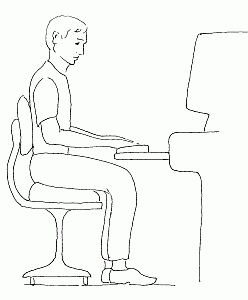
Drawing: correct posture and workstation set up

*Take regular breaks!

When doing close work or computer work, take regular breaks. Every 5-10 minutes look out into the distance for a few seconds, or close your eyes and imagine a scene in the distance.

At least every 30 minutes, get up and stretch, walk around, loosen your head and neck.

Remember that our bodies and eyes weren’t designed to sit and look at one place for long periods of time!

*See beyond where you are looking. It is a habit of nearsighted people especially to think the world ends where they are looking. Look at your computer screen. Are you aware of the room/world beyond it? Or does the world end at the screen?

*Muscles move and focus your eyes, so when you consider vision think motion, strength, coordination, nourishment and rest.

Monitor Placement. For good vision, our eyes need to make tiny, fast movements over the object we want to see. They love moving and need the freedom to do so. A larger screen allows for more motion. Place it so that the top of the screen is at your eye level. This will allow your eyes to look slightly downwards, which is more comfortable for them when doing prolonged near work. Place it at about arm’s length or where you can see it clearly. If you can get an LCD screen, do so. There is no flicker, which is more restful for the eyes.

Avoid glare from lights shining in your eyes and on the screen from lights behind you or reflected off your white shirt.

If you can place your monitor so you are facing into a room, you will see some depth and space. This will stimulate your peripheral vision as well as your ability to see 3-D. The best vision is binocular (when both eyes are used together), and we perceive the depth of the world. When we look at 2-D screens all day we tend to lose the habit of seeing depth. The world becomes flatter, less interesting and visually exciting. For happy eyes we want to feed them beauty and spaciousness.

Eye Use. When we repeatedly do the same muscular activity our muscles tire quickly. If we vary those activities our muscles can keep going for much longer. Working at a computer requires the eyes to be constantly focused at the monitor. Whether we’re just checking emails or putting in an 8-hour day, the eye muscles must be held at this fixed distance and they tend to tire. We can remedy this by changing our length of focus about every 5 – 10 minutes and looking at something 20 feet or more away. Our eyes don’t really focus unless our mind focuses, so allow your attention to shift to whatever you are looking at. Look for about 10 seconds, or until you have refocused at that distance. (Tell your boss that studies show you are more productive when your eyes are comfortable.)

Most of us don’t have corner offices with a view over Boston Harbor, so we need to be creative. If you are in a small room or cube, you can double the length of your view by putting up a mirror, maybe 18″x12″, in a place where it reflects something further away and is easy for you to look into. If you can arrange things so that you would see something visually pleasing in your mirror, a colorful poster or a window, this would be best. If you can’t have a window, a room or a mirror, close your eyes and imagine looking at a beautiful distant scene as you take a few slow, deep breaths. The eyes nourish us when they look at color and beauty.

More Vision Tips

What Can I do When Small Print Begins to Get Fuzzy?

When your arms seem to be too short and the print blurry, blink gently to refresh your eyes, or close and relax them as if you were palming.

Change focus often to keep the muscles flexible and strong.

Read small print every day as close as you can, to keep the ability to do so. Don’t strain! Relax and see.

Getting the health of your eyes checked is important but so is only wearing glasses if you feel you are straining. Reading glasses do the work of the eye muscles for us. When we don’t use muscles they become weaker and it is even harder to focus.

Rest your eyes frequently. Losing our near vision after a lifetime of seeing well usually occurs after or during a period of stress, such as the death of a loved one, returning to school or a serious illness. Often there is a reduction in sleep and an increase in anxiety. The little muscles that change our focus from far to near are susceptible to both physical and emotional stress and they need to recover.

Some ways to rest your eyes:

Palming: This is a way to deeply rest your eyes. First, find a position where you can support your elbows, breathe fully and relax your body. You might do this at a desk, or with pillows on the couch or lying down in bed. Then, gently cover your closed eyes with your cupped hands. Avoid touching your eyes or putting much pressure on your face. In order to relax the eyes we need to relax the mind and find an alternative to our usual planning and worrying thoughts. Be aware of what you are focusing on. Enjoying the deep, velvety, black spaciousness that you “see” when you cover and close your eyes is wonderful. Or, alternatively, visualizing you are in a beautiful relaxing place, taking pleasure in what you’re seeing, feeling and hearing, can be deeply regenerative. If you palm for 10 minutes or more a day and take shorter palming breaks when you can, your eyes will recuperate their energy and see the print more sharply.

Blinking: Blinking is for the eyes what breathing is for the body. The blink spreads the tears over the eyes to wash them, nourish them and to keep them moist. The average blink is every seven seconds. When we are not seeing well we tend to try harder and stare. This actually makes it more difficult for us to see. Blinking helps us to break up the stare and to focus more accurately.

Changing Focus: When you are doing any task for a while, give your eyes little breaks by looking at something at a different distance. E.g. when reading, sewing, drawing or working at the computer look at something at least 20 feet away every five minutes or so. If you are driving look at the odometer, or in the movies look at your watch or your hand. The eye muscles like variety, just like our other muscles. They become fatigued when they are constantly focused at one distance. If the refocusing is sluggish, blink, breathe and wait for some focal readjustment so the muscles can strengthen.

Just these simple activities may well make reading glasses unnecessary.

More Vision Tips

The Problem With Glasses and Contact Lenses

Originally appeared in
EARTH STAR MAGAZINE December 2004/January 2005
By Rosemary Gaddum Gordon, D.B.O., M.A.

Corrective lenses are a wonderful discovery. Looking through them we instantly see more detail. They fit on the face or cornea and we no longer have to worry about our blurry vision. There’s just one hitch, most people need stronger lenses within a few years. These lenses are not “corrective” as in therapeutic, they are only “corrective” in that they seem to make the problem go away.

Aldous Huxley used the analogy that glasses are like crutches. If we break a leg we use crutches while the bone heals, but we don’t expect to be on them for the rest of our lives. When we remove the cast, the muscles of the hurt leg have weakened, so we do exercises. As we practice we wean ourselves off the crutches and, depending on the injury, can expect to regain most of our previous agility and strength.

Another problem with lenses is that they do not adapt to the natural changes in our eyesight. They have a set shape and power. Normal vision varies. It often becomes less sharp when we are tired, sick or anxious and clearer when we’re content, at peace and in a beautiful place. The prescription we are given may be perfect for how we saw in the doctor’s office, but once outside, circumstances change. If we relax, for instance, our vision will improve and then the prescription is too strong.

It is best to address the underlying problem of the visual disturbance at the time when it occurs. If this is not possible and your vision continues to be blurry or your eyes fatigued, have an eye exam and get some glasses. Wear the glasses for emergencies only and find help with whatever you think is stressing your eyes. It may be physical over-use, emotional stress, mental boredom or any combination of things causing a breakdown of some of your visual skills. The change in your vision is your unique response to your world. It is your body/mind’s way of letting you know that something is out of balance.

If you work with a Vision Educator, besides rebuilding your visual skills, you will get some therapeutic glasses that slightly under-correct you. In this way when you relax you will see clearly and when you don’t see so clearly, you will be reminded to practice the skills you are learning. When you see well through those glasses you get an even weaker pair; gradually, you wean yourself from the lenses.

As you inquire into what the imbalance might be, rest as much as you can. Rest your eyes using some of the techniques described in previous issues like Palming, Blinking and Changing Focus frequently. Rest your whole body by getting more sleep. And rest your mind by doing things that nurture you: spending time in Nature, going to a concert or the movies or just hanging out with friends.

Healing naturally takes time. Whether it’s from a cold, a broken bone or surgery, adequate rest and relaxation allow the process to unfold more effectively, giving us time to listen to our own wisdom as we rediscover our equilibrium.

More Vision Tips